
Thursday, 27 February 2014


Tuesday, 11 February 2014
Study Uses and Gratifications theory and question, which gratifications audiences would gain from each of your studied texts.
Peaky Blinders
Information - Learning; self-education gaining a sense of security through knowledge.
The audience gains gratifications throughout learning throughout about the social, political and historical context from the 1919s, post World War I. A prime example of this is in the scene where Tommy and C.I. Chester Cambell meet up in a tea room. In this scene Tommy talks about the significant happenings during this time, an example being that he threatens to sell the machine guns to the IRA, who were seen as a major threat due to the risks of civil war. Also he refers to the communists, who were also seen as an upcoming threat, revolving against the capitalist society in the 1919s. Also in a scene between Tommy and Grace, when Tommy is riding his white horse throughout we hear the digetic sound of the industrial machinery and work, also giving insight to the idea that the industrial revolution has already happened and taken affect. This gratification will appeal to an active audience, who would appreciate the content of the text, and decode it notice the information given.
Information - Learning; self-education gaining a sense of security through knowledge.
The audience gains gratifications throughout learning throughout about the social, political and historical context from the 1919s, post World War I. A prime example of this is in the scene where Tommy and C.I. Chester Cambell meet up in a tea room. In this scene Tommy talks about the significant happenings during this time, an example being that he threatens to sell the machine guns to the IRA, who were seen as a major threat due to the risks of civil war. Also he refers to the communists, who were also seen as an upcoming threat, revolving against the capitalist society in the 1919s. Also in a scene between Tommy and Grace, when Tommy is riding his white horse throughout we hear the digetic sound of the industrial machinery and work, also giving insight to the idea that the industrial revolution has already happened and taken affect. This gratification will appeal to an active audience, who would appreciate the content of the text, and decode it notice the information given.
Thursday, 6 February 2014
How does Peaky Blinders attract its audience?
Steven Knight's, Peaky Blinders is a BBC2 crime drama, set in 1919. It follows the soldiers who have returned home from World War I and created a an illegitimate business as well as forming a criminal gang.
One way in which Peaky Blinders attracts it audience is through retrophilia which is 'is a term used to describe aspects of modern culture which are consciously derivative or imitative of those trends, modes, fashions, or attitudes of the recent past which have or had come to be seen as unfashionable.' This complies with the Uses and Gratifications theory, as the audience gains information from the 1919s from this text, whilst enjoying the text as well as learning from it at the same time. Peaky Blinders provides the audience with culturally and historical knowledge throughout the narrative, and an example of this is through the character of Aunt Polly, who has experienced power through men being away at war, and know they are back she wants to restore that power and remain a dominant figure within the shelby family. In the second episode after Tommy has gained a larger turnover after fixing a race, Aunt Polly confronts him on fixing the race without gaining permission from Billy Kimber.
Thursday, 30 January 2014
Explore the different ways in which audiences and/or users respond to you chosen texts.
Explore the different ways in which audiences and/or users respond to you chosen texts.
- Provides Inspiration for other shows:
- Provides Inspiration for other shows:
Is Breathless just another Mad Men clone? The Guardian http://www.theguardian.com/tv-and-radio/tvandradioblog/2013/oct/10/breathless-mad-men-clone-jack-davenport
In this regard, Matthew Weiner's Mad Men now seems established as the iPhone of small-screen writing. Breathless is the latest UK wannabe, and begins tonight (ITV, 9pm), in a week when another of the US impersonators started screening here: Masters of Sex (9pm, Tuesdays, Channel 4).
Both shows carefully follow the template set by Mad Men, of recreating a period from the middle of the 20th century with loving attention to the sorts of clothes, cars and conversations people would have had then, but with a knowing modern acknowledgement that such levels of sexism and smoking should probably not be attempted today.
The sexist profession being dramatised is gynaecology rather than advertising, but the central character – saturnine surgeon Mr Otto Powell, played by Jack Davenport– is very recognisably a transatlantic half-brother of Jon Hamm's Don Draper, even down to the suggestion – from the episode-one revelation that he keeps a gun in a drawer – that he has a secret and possibly even a secret life. Isn't Otto, after all, an uncommon name for an English smoothie?
This series (developed by Michelle Ashford for Showtime) has less room than its inspiration to make the central character mysterious – Dr William Masters, played by Michael Sheen, was a historical figure – although, like Don Draper, he did to some extent reinvent himself, being a stuffy medic who turned into a pioneer of sex therapy.
-Issues of Narrative
http://blogs.indiewire.com/shadowandact/a-final-appraisal-of-the-black-presence-on-mad-men-season-6
It’s a valid question, since the show takes place during the days of the height of the Civil Rights movement in America, a time when people of color were fighting more than ever before for equality and representation. The defense of some fans is that the series is set in a world where the presence of black characters at a Madison Avenue ad agency simply wouldn’t fit, a world where most blacks were the stock archetypes of elevator operators, nannies, and maids.
The defense of showrunner Matthew Weiner is slightly more nuanced. During Season 5 of the show, in an interview on Charlie Rose, Weiner addressed complaints about the lack of diversity on Mad Men by saying that his aim was not to tell “a wish fulfillment story of the real interaction of white America and black America.” For Weiner, historical accuracy was important - it seemed disingenuous to include more developed black characters on the show too early, during a time when most (white) people were still experiencing the civil rights movement not firsthand but through the images they saw on TV. Weiner added: “Hopefully when we get to the part of the ’60s [where race is more clearly addressed on the show], you won’t have trivialized the contribution of someone like Martin Luther King.”
Tuesday, 10 December 2013
How Typical is your chosen text to its genre?
Fish tank is typical to its genre of, social realism, and conforms to this through the different elements used within scenes, for example the sex scene.
Within this scene when Mia is looking at Connor, we see this in a shot of her point of view. As we see her eyeline in a camera shot of her, which its then edited and cut to a shot of Connor, showing what she is looking at is him. This is typical of the social realism genre because by showing it in her point of view, allowing the audience to feel empathy towards Mia. Another technical convention which adheres mid-shot of Mia resting on Connor's shoulder, this shot is held for longer than what may be seen as necessary, to the point where the audience feels uncomfortable watching. This conforms to the genre as it is a classic technical convention of slow pace, which put the audience in uncomfortable positions which other genres would not.
A narrative theme convention that conforms to social realism is showing issues within society that are not usually shown, in concern to the under class, as well as society not accepting these issues. An example of this, within this sex scene, is the issue of under age sex, as Mia is 15, as well as pedophilia. As in this scene Connor is seen, once again, to be grooming Mia, by complementing her, and showing affection to her, which takes advantage of Mia's naivety.
The mise on scene also conforms to the genre. With the typical unpolished setting of a messy lounge, as well as Connor being shown drinking vodka from the bottle. The setting and props used here are typical to social realism, at it shows part of the problems the under class face, such as drinking problems, as well a unhygienic, small housing leading to poor quality of living. However within this film this is treated as normal, as Mia doesn't hesitate to question Connor drinking vodka straight from the bottle, which may be seen as abnormal and not socially acceptable.
Thursday, 5 December 2013
The Hunger Games contains typical and re-occuring conventions from the Sci-Fi genre. The genre conventions could be categorised as narrative themes, character roles, iconography/mise en scene and technical conventions. The narrative is typical of the genre in many ways.
The narrative theme of a hegemonic society, where these is a distinct class difference, between the ruling class and under class, is present in The Hunger Games. The scene this is evident in is when Katniss and Peeta are taken onto a glamorous train, to reach the capital. The has pristine decor, including diamond channellers, extravagant food, as well as Effie wearing over the top clothing, including a large wig, purple lipstick, pink eyelashes, pale skin, modernised Elizabethan clothing etc...
The narrative theme of a hegemonic society, where these is a distinct class difference, between the ruling class and under class, is present in The Hunger Games. The scene this is evident in is when Katniss and Peeta are taken onto a glamorous train, to reach the capital. The has pristine decor, including diamond channellers, extravagant food, as well as Effie wearing over the top clothing, including a large wig, purple lipstick, pink eyelashes, pale skin, modernised Elizabethan clothing etc...
Tuesday, 3 December 2013
What film noir conventions are present within Drive?
Drive adheres to typical conventions of film noir, within the technical, mise en secene and iconography, character and narrative themes conventions.
Technical Codes
The contrast of low key lighting, throughout, on Ryan Gosling face emphasises the battle of good versus the bad, a connotation which is typical of a noir film, linking with character traits of a cynical protagonist. This is evident within the hotel room scene, when Ryan Gosling has just killed two men, with blood splatted on his face, he slowly walks back into completely dark lighting, this conveys the bad actions he has just done, he then has slight light come into his face, reflecting the element of good, as his reasoning is not only protect himself, as he considers himself as worthless, but instead to protect Irene.
Also the camera angle shots connotes to narrative themes, as it shows the gender politics, typical of film noir. This is also evident in the hotel scene, as when Ryan Gosling is pinning down Blanch, when he's seen, in her perspective, a low angle shot is used, and when Blanch is shown, in his view a high angle shot is used. This evidentially shows she is looking up at him, therefore gaining power, whereas he looks down on her, showing she is lower and less powerful than him, which is also show through him having to protect her.
Narrative Themes
A common narrative theme within the film noir genre is mistrust and paranoia. This is evident in the narrative through Blanch being in on the job, therefore creating mistrust between her and the driver, however there is also mistrust on top of that between the people who she's working with, who actually kill her.
Drive adheres to typical conventions of film noir, within the technical, mise en secene and iconography, character and narrative themes conventions.
Technical Codes
The contrast of low key lighting, throughout, on Ryan Gosling face emphasises the battle of good versus the bad, a connotation which is typical of a noir film, linking with character traits of a cynical protagonist. This is evident within the hotel room scene, when Ryan Gosling has just killed two men, with blood splatted on his face, he slowly walks back into completely dark lighting, this conveys the bad actions he has just done, he then has slight light come into his face, reflecting the element of good, as his reasoning is not only protect himself, as he considers himself as worthless, but instead to protect Irene.
Also the camera angle shots connotes to narrative themes, as it shows the gender politics, typical of film noir. This is also evident in the hotel scene, as when Ryan Gosling is pinning down Blanch, when he's seen, in her perspective, a low angle shot is used, and when Blanch is shown, in his view a high angle shot is used. This evidentially shows she is looking up at him, therefore gaining power, whereas he looks down on her, showing she is lower and less powerful than him, which is also show through him having to protect her.
Narrative Themes
A common narrative theme within the film noir genre is mistrust and paranoia. This is evident in the narrative through Blanch being in on the job, therefore creating mistrust between her and the driver, however there is also mistrust on top of that between the people who she's working with, who actually kill her.
Thursday, 28 November 2013
Establish if our studied film texts representation of gender is complex or stereotypical.
How are males represented in Sin City?
The male characters within Sin City are all violent and dominant. The characters within sin city all essentially convey to fit into both film noir and comic book genre, creating the perfect hybrid.
The characters can be both categorised into both film noir and comic book. Senator Roark, Cardinal Roark, Jackie Boy and the Yellow Bastard fit in to these genres through different traits in how they are represented. Through the comic book genre they are seen as the villains and arch-nemesis's to the protagonists. Through film noir they a represented at white middle age men, except the yellow bastard, who are all in positions of authority and power, however they abuse this power, as well as Yellow Bastard who has technically inherited his power, this also represents the element of corruption in 50s, with the example of Jackie Boy, who is a corrupt cop.
Tuesday, 5 November 2013
Some Secondary Research - Bibliography
"It is like a beam from a lighthouse, only instead of light travelling outwards, appearances travel in."
vimeo.com/51354092 - John Berger - Ways of Seeing Ep.1 BBC4
"Perspective makes the eye the centre of the visible world"
vimeo.com/51354092 - John Berger - Ways of Seeing Ep.1 BBC4
"I, the machine, show you the world the way nay i can see it."
Minifesto 1923 By Dziga Vertow - The Russian Film Director
A lot of advertising is based on making people feel anxious and insecure
Jean Kilbourne Miss Representation
Girls learn to see themselves as objects
Jean Kilbourne Miss Representation
American woman spend between 12-15 thousand dollars a year on beauty products
Miss Representation
97% of publishing companies are owned by Male
Miss Representation
Woman comprise only 16% of all writers, directors, producers, cinematographers and editors
Miss Representation
10% of writers of film are female
Miss Representation
" We replicate the world we grow up in"
Film Director - Miss Representation
digital "touch ups" turn a model into a veritable Barbie doll
http://www.fastcocreate.com/3020948/watch-photoshop-turn-a-woman-into-a-completely-different-woman
Results revealed that women exposed to sexist ads judged their current body size as larger and revealed a larger discrepancy between their actual and ideal body sizes (preferring a thinner body) than women exposed to the nonsexist or no ad condition.
http://psp.sagepub.com/content/25/8/1049.abstract
He believed that in order for advertising to be effective, it should appeal to three innate emotions: love, fear and rage.
John B. Watson
http://psychcentral.com/blog/archives/2011/02/15/the-psychology-of-advertising/
He believed that advertising had to accomplish four things:
"Harry Hollingworth" http://www.theatlantic.com/magazine/archive/1904/01/the-psychology-of-advertising/303465/
 Rosser Reeves - Reality in Advertising.
http://www.bbc.co.uk/blogs/adamcurtis/2010/08/madison_avenue.html
http://www.theatlantic.com/magazine/archive/1904/01/the-psychology-of-advertising/303465/
http://www.bbc.co.uk/blogs/adamcurtis/2010/08/madison_avenue.html
vimeo.com/51354092 - John Berger - Ways of Seeing Ep.1 BBC4
"Perspective makes the eye the centre of the visible world"
vimeo.com/51354092 - John Berger - Ways of Seeing Ep.1 BBC4
"I, the machine, show you the world the way nay i can see it."
Minifesto 1923 By Dziga Vertow - The Russian Film Director
"The ideal image of beauty is becoming more extreme and impossible than ever before."
Jean Kilbourne -Miss Representation A lot of advertising is based on making people feel anxious and insecure
Jean Kilbourne Miss Representation
Girls learn to see themselves as objects
Jean Kilbourne Miss Representation
American woman spend between 12-15 thousand dollars a year on beauty products
Miss Representation
97% of publishing companies are owned by Male
Miss Representation
Woman comprise only 16% of all writers, directors, producers, cinematographers and editors
Miss Representation
10% of writers of film are female
Miss Representation
" We replicate the world we grow up in"
Film Director - Miss Representation
digital "touch ups" turn a model into a veritable Barbie doll
http://www.fastcocreate.com/3020948/watch-photoshop-turn-a-woman-into-a-completely-different-woman
Results revealed that women exposed to sexist ads judged their current body size as larger and revealed a larger discrepancy between their actual and ideal body sizes (preferring a thinner body) than women exposed to the nonsexist or no ad condition.
http://psp.sagepub.com/content/25/8/1049.abstract
Material goods are inserted in the happiest of scenes, they are constantly associated with success, power, admiration, love, ease and self-esteem. In the process of applying this basically behaviourist law of association, the true routes to these outcomes are obscured and replaced by new associations between material consumption and personal realization.
Selling Desire and Dissatisfaction: Why Advertising should be banned From Bhutanese Television Dr. Ross McDonald
Direct marketing influence represents an intentional blurring of the true connection between the ends of aspiration and the immaterial means by which these can be best achieved.
Selling Desire and Dissatisfaction: Why Advertising should be banned From Bhutanese Television Dr. Ross McDonald
If one gives into individualized material desire, one falls into a perpetual state of desire, an insatiable feeling of hunger or of lack.
Selling Desire and Dissatisfaction: Why Advertising should be banned From Bhutanese Television Dr. Ross McDonald
He believed that in order for advertising to be effective, it should appeal to three innate emotions: love, fear and rage.
John B. Watson
http://psychcentral.com/blog/archives/2011/02/15/the-psychology-of-advertising/
He believed that advertising had to accomplish four things:
- Attract a consumer’s attention
- Focus the attention onto the message
- Make the consumer remember the message and
- Cause the consumer to take the desired action (this really determined the effectiveness of an ad)
'Sure, we sometimes get a token man-ass-shot during a sex scene, but in actual screen time most sex scenes are almost completely shot at an angle zooming in on the woman’s breasts, naked arched back or orgasmic face.'
Posted By Bitch Flicks - http://www.btchflcks.com/2013/06/the-malefemale-gaze-on-bbc-americas-first-season-of-orphan-black.html#.UntqORZgPHh

http://www.bbc.co.uk/blogs/adamcurtis/2010/08/madison_avenue.html
http://www.theatlantic.com/magazine/archive/1904/01/the-psychology-of-advertising/303465/
http://www.bbc.co.uk/blogs/adamcurtis/2010/08/madison_avenue.html
Thursday, 24 October 2013
Are females constructed in
an unrealistic manner in order to help boost sales? Playing particular
attention to the J'adore Dior perfume campaign and the Daisy Perfume by Marc
Jacobs.
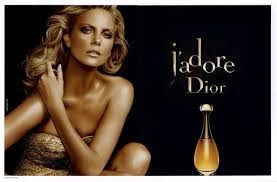
The representation of women is constructed with in advertising products, specifically perfume campaigns, and within this women's representation differs within this element of the media. I intend to prove this with examples of J'adore Dior and Daisy Perfume by Marc Jacobs perfume campaigns. My aim is to see what ideologies brands attach to their products, as through brands attaching specific images and aspirations to their products this therefore help sell their products. In J’adore Dior’s advert Charlize Theron very sexualised and objectified, as well as selling aspirations of her being powerful, sexy and womanly, which is appealing to bother women and men. However Marc Jacobs, Daisy Perfume advert represents young, youthful women and sells the aspirations of being young, cute, pure and innocent, which influences majority of teenage girls age 15-19 to buy this product, however it may also appeal to older women who aspire to once again be young. I will also analyse whether females are always objectified and if this appeals not only to the women who buy the product, but also the men, which the Dior campaign as well as how successful the campaigns were, in terms of how well the campaigns were received and sold. To do this I will investigate how successful the sales of the perfumes were, as well as the successes of the adverts alone. I will also apply specific theories, which will be, Laura Mulvey's theory on the 'male gaze', and how the objectification of women is therefore appealing to men, as well as women, who may view this as aspiring. Another theory i will apply is uses in gratifications, where i will explain and analyse the reasons people are engaged in these adverts and therefore what gratifications they gain from this, plus the hyper reality strand of post modernism, in which these adverts give a sense of false reality.
The representation of women is constructed with in advertising products, specifically perfume campaigns, and within this women's representation differs within this element of the media. I intend to prove this with examples of J'adore Dior and Daisy Perfume by Marc Jacobs perfume campaigns. My aim is to see what ideologies brands attach to their products, as through brands attaching specific images and aspirations to their products this therefore help sell their products. In J’adore Dior’s advert Charlize Theron very sexualised and objectified, as well as selling aspirations of her being powerful, sexy and womanly, which is appealing to bother women and men. However Marc Jacobs, Daisy Perfume advert represents young, youthful women and sells the aspirations of being young, cute, pure and innocent, which influences majority of teenage girls age 15-19 to buy this product, however it may also appeal to older women who aspire to once again be young. I will also analyse whether females are always objectified and if this appeals not only to the women who buy the product, but also the men, which the Dior campaign as well as how successful the campaigns were, in terms of how well the campaigns were received and sold. To do this I will investigate how successful the sales of the perfumes were, as well as the successes of the adverts alone. I will also apply specific theories, which will be, Laura Mulvey's theory on the 'male gaze', and how the objectification of women is therefore appealing to men, as well as women, who may view this as aspiring. Another theory i will apply is uses in gratifications, where i will explain and analyse the reasons people are engaged in these adverts and therefore what gratifications they gain from this, plus the hyper reality strand of post modernism, in which these adverts give a sense of false reality.
Thursday, 17 October 2013
Tuesday, 15 October 2013
A1. To what extent are your chosen texts typical of their genre?
Sin City hybrid genre of Film noir and comic book. There a several things within this that a typical to its genre.
In Sin City all the protagonist are seen wearing trenched coats. However these trench coats are used to represent cloaks, typical of a comic book genre, as the super hero is usually seen wearing a cloak. This is also stereotypical of film noir, which was typically set in the 1940s-1950s, which sometimes involved this icon coats being worn, as protagonist in film noir films were often detective. Marv is seen wearing this coat, as well as the other protagonists, and during a scene where he beats up to 'messengers' to find out where the man who killed Goldie was he removes he's coat, showing that this goes against the serotype of a superhero, however when running through the streets, you see his coats flapping in the background, stereotypical of a superhero, and a comic book genre.
Also the femme fatale is stereotypical to a film noir genre, as throughout they use their sexuality to gain there power in return for his protection, however they are also seen as naïve and reliant on men, which is stereotypical to comic book genre, as they're saved by their superhero protagonist male. Goldie uses her sexuality to gain Marv's love and affection therefore gaining power over him in order to get protection, however she is killed, but this then goes on to be the reason Marv risks everything for her, linking with film noir genre, as in this time period, people saw life as insignificant due to the threat of the cold war.
A convention which is also typical to comic book genre is the use of silhouettes. This is used a times throughout the film, and example being when John Hartigan shoots himself at the end, we see it in a silhouette, relating with the original genre of the comic book genre. Also through the use of a voice over, which all protagonists also use, typical to film noir genre, we are able to gain insight to floors, John Haritigans being a heart problem, and old age, which is reflected through 'come on old man, prove you're still a damn.' Also through the voice over we gain context to the time period, as Hartigan say 'An old man dies. A little girl lives. Fair trade.', this being he values Nancy's life more than his own, which was typical during the 1940/50s due to the threat of the cold war, also being typical of a protagonist putting his femme fatale first, typical of the film noir convention.
In Sin City all the protagonist are seen wearing trenched coats. However these trench coats are used to represent cloaks, typical of a comic book genre, as the super hero is usually seen wearing a cloak. This is also stereotypical of film noir, which was typically set in the 1940s-1950s, which sometimes involved this icon coats being worn, as protagonist in film noir films were often detective. Marv is seen wearing this coat, as well as the other protagonists, and during a scene where he beats up to 'messengers' to find out where the man who killed Goldie was he removes he's coat, showing that this goes against the serotype of a superhero, however when running through the streets, you see his coats flapping in the background, stereotypical of a superhero, and a comic book genre.
Also the femme fatale is stereotypical to a film noir genre, as throughout they use their sexuality to gain there power in return for his protection, however they are also seen as naïve and reliant on men, which is stereotypical to comic book genre, as they're saved by their superhero protagonist male. Goldie uses her sexuality to gain Marv's love and affection therefore gaining power over him in order to get protection, however she is killed, but this then goes on to be the reason Marv risks everything for her, linking with film noir genre, as in this time period, people saw life as insignificant due to the threat of the cold war.
A convention which is also typical to comic book genre is the use of silhouettes. This is used a times throughout the film, and example being when John Hartigan shoots himself at the end, we see it in a silhouette, relating with the original genre of the comic book genre. Also through the use of a voice over, which all protagonists also use, typical to film noir genre, we are able to gain insight to floors, John Haritigans being a heart problem, and old age, which is reflected through 'come on old man, prove you're still a damn.' Also through the voice over we gain context to the time period, as Hartigan say 'An old man dies. A little girl lives. Fair trade.', this being he values Nancy's life more than his own, which was typical during the 1940/50s due to the threat of the cold war, also being typical of a protagonist putting his femme fatale first, typical of the film noir convention.
Tuesday, 8 October 2013
A1. To what extent are your chosen texts typical of their genre?
The text 'Fish Tank' is both typical of the genre social realism.
Ways in which the text is is through the use of camera shots. Throughout the film, the vast majority of camera shots is through a hand held camera. Through the use of this it enable the audience to feel empathy towards the characters in the text, as this enables them to be part of their reality, typical of the genre text. An example of a scene in which this is used is during the scene with Mia and Connor's daughter on the beach. During this scene on the edge of a rock, Mia and Connor's daughter are fighting, and random shots and aimed around, creating disorientation for the audience, as well as Mia and Connor's daughter. This allows the audience to feel empathy towards them, through the use of the camera work, as it then means they feel involved within the the piece, and therefore feeling empathy for them.
Another feature of the text that is typical of social realist genre is diegetic sound, as during in this text no non-diegetic sound is used. The use of diegetic sound helps create the real atmosphere. An example of this is in the scene after Connor has left, and Mia is walking along the road trying to call Connor. During this scene their is noises of cars driving past Mia, as she tires to shout over the noise of the cars, this helping to create a realistic,
Ways in which the text is is through the use of camera shots. Throughout the film, the vast majority of camera shots is through a hand held camera. Through the use of this it enable the audience to feel empathy towards the characters in the text, as this enables them to be part of their reality, typical of the genre text. An example of a scene in which this is used is during the scene with Mia and Connor's daughter on the beach. During this scene on the edge of a rock, Mia and Connor's daughter are fighting, and random shots and aimed around, creating disorientation for the audience, as well as Mia and Connor's daughter. This allows the audience to feel empathy towards them, through the use of the camera work, as it then means they feel involved within the the piece, and therefore feeling empathy for them.
Another feature of the text that is typical of social realist genre is diegetic sound, as during in this text no non-diegetic sound is used. The use of diegetic sound helps create the real atmosphere. An example of this is in the scene after Connor has left, and Mia is walking along the road trying to call Connor. During this scene their is noises of cars driving past Mia, as she tires to shout over the noise of the cars, this helping to create a realistic,
Tuesday, 1 October 2013




Tuesday, 24 September 2013
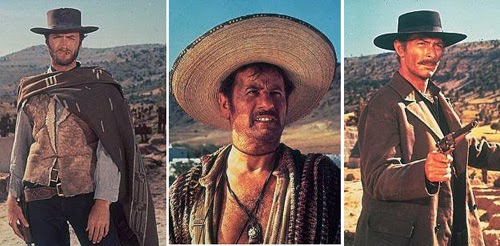
The film The Good, The Bad and The Ugly is typical of its western genre by iconography, narrative, representation and ideologies.
 Iconography
Firstly TGTBTU contains key iconography which connotes the western genre. Examples of this can be shown in the mise en scene, as the setting is within an uninhabited desert and graveyard, which is used as a conventional setting in western genre films. Also the use of guns during a showdown, plus referring back to the mise en scene the costumes also show a key concept of ideology within western genre films, from the ponchos, cowboy boots, belts, stetson etc...
Narattive
A theory that could be applied to TGTBTU is Propp's narrative theory, which could also be applied to many other western genre films. An example of this within in the film is application of the stereotypical characters, with a good guy and a bad guy, and the good guy always winning, for example he wins the showdown.
Firstly TGTBTU contains key iconography which connotes the western genre. Examples of this can be shown in the mise en scene, as the setting is within an uninhabited desert and graveyard, which is used as a conventional setting in western genre films. Also the use of guns during a showdown, plus referring back to the mise en scene the costumes also show a key concept of ideology within western genre films, from the ponchos, cowboy boots, belts, stetson etc...
Narattive
A theory that could be applied to TGTBTU is Propp's narrative theory, which could also be applied to many other western genre films. An example of this within in the film is application of the stereotypical characters, with a good guy and a bad guy, and the good guy always winning, for example he wins the showdown.
Thursday, 19 September 2013
The James Bond franchise is a clear example of the film objectifying females and forcing the audience to view females via the male gaze. the scene within "Die Another Day" when James Bond meets the character Jinx demonstrates my previous statement by the following technical conventions:
- Camera Shots and vignette - When Jinx fist emerges from the water, she is seen through James Bond's binoculars, therefore putting the viewers, male or female in the view of a mans, hence the vignette, and a mid shot. This enables us to see her face as well as her body and her body movements, however it also restricts the the audience completely in being able to see anything else other than Jinx, this therefore makes the audience focus on Jinx and her body, objectifying her through the
- Slow motion - This postproduction technique allows the viewers to gain more time for visual pleasure. This is because it exaggerates her over the top movement, of her throwing her arms up in the air, this enhances the movement of the chest region, which therefore objectifies her, and by giving the male viewers and James Bond himself the pleasure in admiring this, which is also enhanced by her bikini, as this also shows her body, and curves, as well as her enhanced hip movements when walking.
-
- Camera Shots and vignette - When Jinx fist emerges from the water, she is seen through James Bond's binoculars, therefore putting the viewers, male or female in the view of a mans, hence the vignette, and a mid shot. This enables us to see her face as well as her body and her body movements, however it also restricts the the audience completely in being able to see anything else other than Jinx, this therefore makes the audience focus on Jinx and her body, objectifying her through the
- Slow motion - This postproduction technique allows the viewers to gain more time for visual pleasure. This is because it exaggerates her over the top movement, of her throwing her arms up in the air, this enhances the movement of the chest region, which therefore objectifies her, and by giving the male viewers and James Bond himself the pleasure in admiring this, which is also enhanced by her bikini, as this also shows her body, and curves, as well as her enhanced hip movements when walking.
-
Wednesday, 18 September 2013
Stereotypes
Mr and Mrs Smith Trailer
In this trailer, Angelina Jolie, who plays Jane Smith, goes against the stereotypical view of a woman. This is because she is seen as being equally as powerful as her husband, Prad Pitt, who plays John Smith.
Mr and Mrs Smith is about a married couple, who feel the spark and mystery in their relationship is lost, but they soon discover they are both enemy assassins and the target is eachother.
Jane is seen at first as being a stereotypical housewife her class is seen as middle calls, with a grand house, she's white American in her 30s and her sexuality is heterosexual.
Firstly at the begging of the films, Jane Smith is seen as being an ordinary housewife, she cooks, cleans, makes dinner for her huspand everyday, etc... However we are then revealed that Jane Smith is an assassin. Through this we then see her as being a powerful woman, however it is arguable that her power is taken away from her through her being sexually objectified, however you could also say that she gains her power through being sexualised, as a sexualised woman can be seen as being intimidating to alot of men.
When Jane returns home she wears long skirts and shirts and cardigans, a stereotypical outfit of a female housewife. When being seen as an assassin Jane is seen wearing all black, and in one scene when she visits a man in a hotel who she then kills, she is wearing a short black leather dress with a whip, during this scene she's seen as having full control over the man, because she is sexualised he follows all her instructions etc... Which then leads to her killing him, going against the stereotypical role of a housewife.
As the filmsm goes on Jane is seen as an equal to her husband, this is shown through a fighting scene when it appears John is winning and he says "come on sweetheart come to daddy" and then Jane gets up and punches John and says "who's the daddy now". This goes against the traditional stereotype of a woman being weaker than a man, who would usually be seen as a masculine alpha male,nhowever Jane goes against this by winning a fight against her husband.
Tuesday, 17 September 2013
My Favourite Tv Programme
90210
My favourite TV programme is 90210. 90210 is about of young group of adults, and the drama and challenges they face in their everyday life in Beverly Hills.
 It has been on screen for five years, meaning that many of the viewers have
grown up watching it, being the same age as many of the members of cast, this
helps gain a gratification from 90210 through personal identity. This is
because it finds models of behaviour, as many members of the audience think the
characters in 90210 are aspirational, this may be through the way they act and
behave, but also the way they dress, look etc...
It has been on screen for five years, meaning that many of the viewers have
grown up watching it, being the same age as many of the members of cast, this
helps gain a gratification from 90210 through personal identity. This is
because it finds models of behaviour, as many members of the audience think the
characters in 90210 are aspirational, this may be through the way they act and
behave, but also the way they dress, look etc... Another gratification is information, as the audience may watch 90210 to seek advice on practical matters or opinion and decision choices. This also links in with it being on television for five years, as it goes through the same stages of life as it's audience, for example problems at school occurred in the first few series, following up through to college, these problems then related to the audiences’ everyday life, and problems they also face, and the audience sees how they overcome and face their problems, influencing how they also face their problems.

Thursday, 12 September 2013
Niche and Mainstream audiences
A niche audience is a targeted group of people that are specific to a media text, it usually consists of a small amount of people. Niche media texts may be shown on less popular television channels and may cost extra, and not during peak times, and is of a non-popular specific interest to a small group of people. Niche audiences must be passive. e.g. wheeler dealers, storage hunters, MUTV, countryfile, peaky blinders etc...

A mainstream audience is a wider range targeted group of people, which appeals to a larger amount of people. It is shown on the main channels, and during peak times, it consists of programmes which provide a wide range of interest for all audiences, and there is more gratifications appealing to the audience. Mainstream audiences are also developed through an ensemble cast, an example of this is LOST. e.g. x-factor, big brother, eastenders etc...



A mainstream audience is a wider range targeted group of people, which appeals to a larger amount of people. It is shown on the main channels, and during peak times, it consists of programmes which provide a wide range of interest for all audiences, and there is more gratifications appealing to the audience. Mainstream audiences are also developed through an ensemble cast, an example of this is LOST. e.g. x-factor, big brother, eastenders etc...

Subscribe to:
Posts (Atom)